

Key Takeaways
- Compliance depends on location
Rules vary by state and local laws, with no single national standard. - Classification shapes requirements
How your home is defined determines licensing, certification, and oversight. - NARR standards drive expectations
Even if optional, they’re often required for referrals and credibility. - Compliance covers multiple areas
Includes zoning, safety, staffing, documentation, and overdose response. - It’s an ongoing process
Staying compliant requires consistent recordkeeping and regular updates.
Running a sober living home means more than keeping the house organized and substance free. Operators also need to understand the rules that apply in their state, city, and county, because compliance for recovery housing is not handled the same way everywhere in the United States.
The Substance Abuse and Mental Health Services Administration (SAMHSA) describes recovery housing as a vital recovery support and defines recovery houses as safe, healthy, family-like substance-free living environments centered on peer support and connection to services that promote long-term recovery.
That broad definition is helpful, but it does not create one national rulebook. In practice, sober living compliance is a patchwork of state certification programs, licensing rules, health and safety requirements, resident-rights protections, zoning laws, and documentation expectations.
The National Alliance for Recovery Residences (NARR) explains that its national standard guides certification and distinguishes four levels of recovery-oriented housing and services, which is one reason operators first need to understand what kind of residence they are actually running.
Compliance starts with knowing how your state defines your home
The first compliance step is identifying whether your state treats your program as a recovery residence, sober living home, recovery house, residential treatment setting, or something else entirely. That matters because the label can determine whether you need certification, full licensure, simple registration, or no state credential at all. Indiana, for example, says recovery residences include sober living homes and notes that the state certifies Levels II, III, and IV while using NARR quality standards and code of ethics as the basis for much of that process.
Other states take a more direct licensing approach. Pennsylvania says recovery houses must get a license if they want to accept referrals from state agencies or state-funded facilities, or receive federal or state funding to deliver recovery house services. The Commonwealth also states that its licensure rules are designed to protect residents in areas such as health and safety, finances, and resident rights.
Some states have a statewide certification structure. Maryland, for instance, says its Maryland Certification of Recovery Residences office provides statewide certification for recovery residences serving people with substance-related or addictive disorders.
Others require registration even when the system is not identical to a full license. Ohio says operators of recovery housing residences must file with the Department of Behavioral Health under state law, with separate filings required for each address, while Level IV residences are treated differently and certified as residential treatment.
Arizona shows how sober living compliance can also include state licensing plus business-related requirements. Arizona’s small business guidance says anyone operating a facility that meets the statutory definition of a sober living home must obtain a license from the Arizona Department of Health Services, and operators leasing or renting residential real property may also be subject to tax or licensing obligations tied to residential rental activity.
What sober living compliance usually includes
Even though state rules differ, most sober living operators need to review the same compliance guide categories before opening and on an ongoing basis.
Common areas include:
• State certification, licensure, or registration requirements
• City or county zoning and occupancy rules
• Business formation, tax, or rental licensing requirements
• Fire and life-safety standards
• Written house rules and resident-rights policies
• Incident reporting and documentation procedures
• Staff training requirements
• Medication and overdose-response policies, including naloxone where required or strongly recommended
• Referral restrictions tied to public funding, courts, or treatment providers
• Renewal inspections, corrective actions, and recordkeeping expectations
NARR standards matter even when your state does not directly regulate every home
A major mistake operators make is assuming that if their state does not require a full license, compliance is minimal. In reality, NARR standards often shape what referral partners, courts, agencies, and state affiliates expect. NARR says its standard provides guidance for certifying effective recovery residences, and state affiliates are the entities that certify and recertify individual residences rather than NARR itself doing that directly.
That means operators should review whether their state has a NARR affiliate and whether certification is expected for credibility, referrals, or contracts. In some markets, certification may be technically voluntary but practically necessary if the goal is to build trust with treatment providers, probation systems, families, and community partners.
Narcan and overdose response are becoming harder to ignore
Compliance is not only about licenses and inspections. It also includes whether the home is prepared to respond safely to emergencies. CDC says naloxone is a life-saving medication that can reverse an opioid overdose, and its most recent public guidance states that nearly 80,000, or about 76%, of the 105,007 drug overdose deaths in 2023 involved an opioid. CDC also says a potential bystander was present in nearly 43% of overdose deaths in 2023.
That is why naloxone access is increasingly relevant for sober living operations. New York’s recovery residences guidance says certified providers must maintain emergency medical kits at each certified location, and those kits must include naloxone in quantities sufficient to meet the needs of the residence. The same guidance says staff and residents must also be trained in naloxone administration. California has also tied naloxone availability and the ability to properly dispense it to certain recovery residence contract requirements.
Not every state uses the exact same wording, but the direction is clear. Operators should check whether naloxone is required, recommended, or effectively expected by certifying bodies, state agencies, insurers, or referral partners. Even where not explicitly mandated, it is increasingly part of what responsible recovery housing looks like.
Fair housing still matters
Sober living operators also need to understand that compliance is not just about following restrictions. It is also about recognizing legal protections. The joint HUD and DOJ guidance on group homes explains that state and local governments must consider reasonable accommodations to licensing and regulatory requirements where necessary to afford individuals with disabilities an equal opportunity to use and enjoy a dwelling. The same guidance also says local governments violate the law if they block a group home because of neighbors’ stereotypical fears or prejudices about persons with disabilities.
That does not mean sober living homes are exempt from every neutral rule. It does mean operators should be careful, informed, and well documented when zoning or land-use disputes come up. A home may still need to meet lawful health and safety rules, but enforcement cannot be discriminatory.
Documentation is part of compliance, not just administration
Once a home is operating, compliance becomes an everyday process. Pennsylvania requires licensed recovery houses to report unusual incidents and respond to plans of correction when applicable. Ohio requires updated filings when submitted information changes. State systems like these make one thing very clear: staying compliant is ongoing, not one and done.
Operators should have current records for admissions, resident agreements, house rules, incident reports, inspections, training, emergency procedures, and any certification or licensing renewals. When documentation is scattered across paper files, texts, and email threads, it becomes much harder to show consistency during an audit, inspection, complaint, or referral review. That operational burden grows fast once an organization manages more than one house.
What this looks like in practice
In practice, a compliant sober living home should know exactly which agencies oversee it, what credentials are required for its level of housing, what local business and property rules apply, what emergency-response supplies and training must be on site, and how resident documentation will be stored and updated. Good compliance work is not reactive. It is built into daily operations from the start.
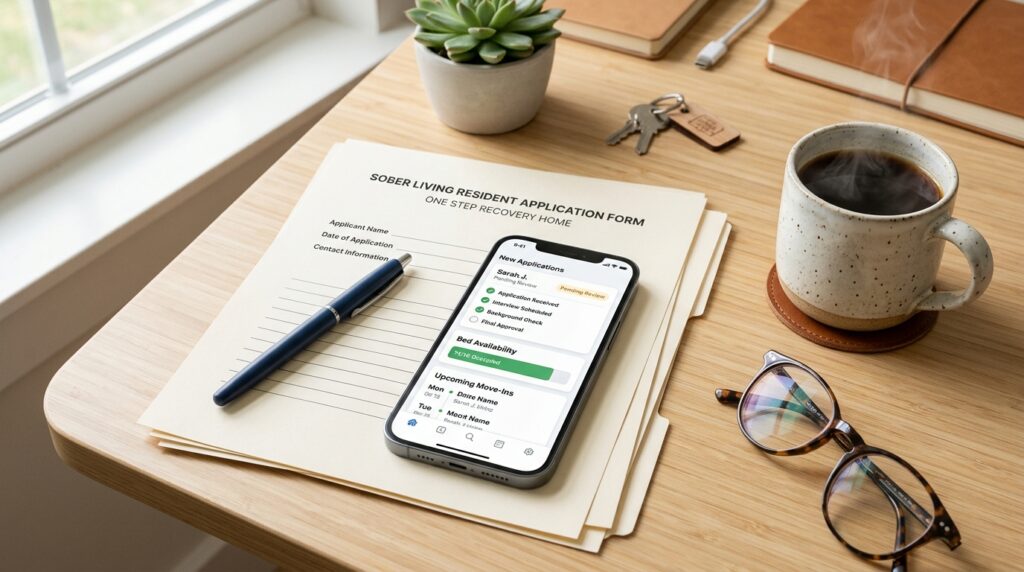
That is where software can help. One Step Software positions its sober living platform around visibility, accountability, and operational tracking for recovery housing programs. For operators trying to keep resident records, incident logs, communication, and compliance-related documentation organized in one place, that kind of system can make it easier to stay consistent as the program grows.
FAQs
Do sober living homes need a license?
It depends on the state. Some states require a license or certification to operate a recovery residence, while others only require registration or compliance with local zoning and safety rules.
Do sober living homes have to follow NARR standards?
Many states use the National Alliance for Recovery Residences (NARR) standards as the basis for certification. Even where certification is voluntary, many referral partners expect homes to follow these guidelines.
Are sober living homes required to keep Narcan on site?
Some states and certification programs require recovery residences to keep naloxone (Narcan) available and train staff or residents to use it. In other areas it may not be mandatory but is widely considered a best practice for overdose response.
What records should sober living homes keep?
Operators should maintain clear documentation such as intake forms, resident agreements, incident reports, house rules, and communication logs to demonstrate accountability and consistency.
Can local zoning laws affect sober living homes?
Yes. Cities and counties may regulate occupancy, zoning, and safety requirements, although federal fair housing laws can also protect recovery housing from discriminatory restrictions.