

Running a sober living home is demanding. You are supporting people who are early in recovery, often overwhelmed themselves, while also managing rent, rules, compliance, referrals, and staff. While operators care deeply about recovery outcomes, many are stretched thin and rely on spreadsheets, paper logs, and constant manual check-ins just to keep things moving.
Research increasingly shows that digital support tools can strengthen recovery outcomes. A randomized controlled trial published in JAMA found that individuals using a smartphone-based recovery support system experienced nearly 50% fewer risky drinking days compared to those receiving standard care alone. And according to SAMHSA, approximately 10 million Americans live with a substance use disorder but do not receive treatment—making recovery housing and its supporting tools more critical than ever.
How Does Structure and Accountability Drive Recovery?
Decades of research show that recovery outcomes improve when individuals have consistent structure, clear expectations, and accountability. Research cited by the National Institute on Drug Abuse has found that recovery housing models are associated with lower relapse rates and improved employment outcomes, particularly when residents stay longer and participate in peer accountability systems.
Technology helps maintain that structure consistently. When curfews, meetings, and drug testing are tracked the same way every time, expectations feel clear and fair. Residents know what is required of them. Staff do not have to rely on memory, handwritten notes, or repeated follow-ups. According to the Substance Abuse and Mental Health Services Administration, recovery environments that combine accountability with peer and staff support are linked to greater long-term stability.
“Digital technologies offer some of our most promising new tools for extending addiction treatment beyond the clinic and into everyday life—reaching people in the moments and environments where they need support most.”
- Consistent curfew tracking removes ambiguity for residents
- Automated reminders reduce the need for staff follow-up on routine tasks
- Standardized workflows apply rules fairly across all residents and shifts
Do Digital Check-ins Actually Reduce Gaps in Accountability?
Meeting attendance is a core requirement in most sober living homes. Yet many programs still rely on paper slips or verbal confirmation. These methods are easy to lose, manipulate, or forget to log, and they place additional pressure on staff to verify information.
Research in digital health shows that verified check-ins improve adherence to recovery-related activities. Studies indexed by the National Institutes of Health have found that mobile health tools using time and location verification reduce missed activities and false reporting, while also lowering staff oversight burden.
This is where resident-facing mobile tools make a practical difference. With One Step’s resident mobile app, residents can check into AA or NA meetings directly from their phones using built-in geolocation. The system confirms that the resident is physically present at the meeting location, removing guesswork and eliminating the need for paper slips or manual verification.
“Technology-based interventions for substance use disorders have demonstrated efficacy comparable to in-person counseling in multiple trials, and their scalability means we can reach populations that would otherwise go unsupported.”
- Geolocation check-ins confirm physical presence at meetings automatically
- No paper slips to lose, forge, or chase down
- Records are instantly available to house managers without manual data entry
When meeting check-ins are verified automatically, accountability improves without confrontation. Staff are no longer placed in the role of enforcer, and residents are less tempted to cut corners. Expectations stay clear, records stay accurate, and the system supports honesty by design.
Can Journaling and Mood Tracking Prevent Relapse?
Early recovery is often emotionally volatile. Stress, anxiety, shame, and frustration frequently surface before relapse. Research consistently shows that self-monitoring tools, including journaling and mood tracking, help individuals recognize emotional patterns and regulate reactions before they escalate.
NIH-supported research has shown that digital journaling tools can improve self-awareness and emotional processing in individuals recovering from substance use disorders. Studies suggest that residents who engage in daily self-monitoring are significantly more likely to complete their program than those who do not.
This kind of support works best when it is built into daily routines. One Step’s resident mobile app allows residents to track their mood each day and journal directly within the app, creating a simple, private way to reflect without added pressure. Mood check-ins are shared with the sober living team at a high level, giving staff visibility into trends while still respecting resident privacy.
“The A-CHESS system showed us that a smartphone app can serve as a recovery coach in a resident’s pocket—available at any hour, in any situation, providing support precisely when craving and relapse risk are highest.”
- Daily mood check-ins help residents identify emotional triggers early
- Journaling creates a private space for reflection that supports therapy sessions
- Aggregated mood trends help staff spot residents who may need additional support
- Low-friction daily habits build the emotional regulation skills central to lasting recovery
These tools do not replace therapy or peer support. They create a low-friction space for daily reflection and emotional check-ins. For residents, journaling and mood tracking become easier to maintain. For operators, aggregated mood trends can signal when additional support may be needed, without reading personal journal entries or crossing boundaries.
Why Does Peer Connection Between Meetings Matter So Much?
Recovery does not only happen during meetings. It happens in the quiet hours between them. Public health research shows that social connection reduces isolation, which the Centers for Disease Control and Prevention identifies as a significant risk factor for relapse.
“Recovery is fundamentally a social process. The quality and continuity of social connection—particularly among peers who understand the experience—is one of the strongest predictors of long-term recovery success we have identified in the research.”
Group messaging tools designed for recovery housing allow residents to encourage one another, ask for help, and stay connected in appropriate ways. One Step’s resident mobile app includes built-in group messaging, giving residents a structured space to communicate with peers and staff without relying on informal text threads or personal phone numbers. This keeps communication centralized, appropriate, and aligned with house expectations.
- Structured in-app messaging replaces unmanageable informal text threads
- Staff stay informed without needing access to personal communications
- Residents rebuilding trust benefit from visible, accountable communication channels
Unlike scattered text messages, in-app messaging helps maintain clear boundaries while still supporting connection. It is especially valuable for residents who are rebuilding trust, communication skills, and healthy routines. Technology does not create community, but when designed for sober living, it can support connection by keeping communication visible, organized, and grounded in accountability.
How Does Digital Documentation Protect Residents and Operators?
Documentation is not just a compliance requirement. It protects residents by ensuring fairness and transparency, and it protects operators by creating clear records of expectations, incidents, and progress. The National Association of Recovery Residences consistently emphasizes documentation as a key factor in program credibility and sustainability.
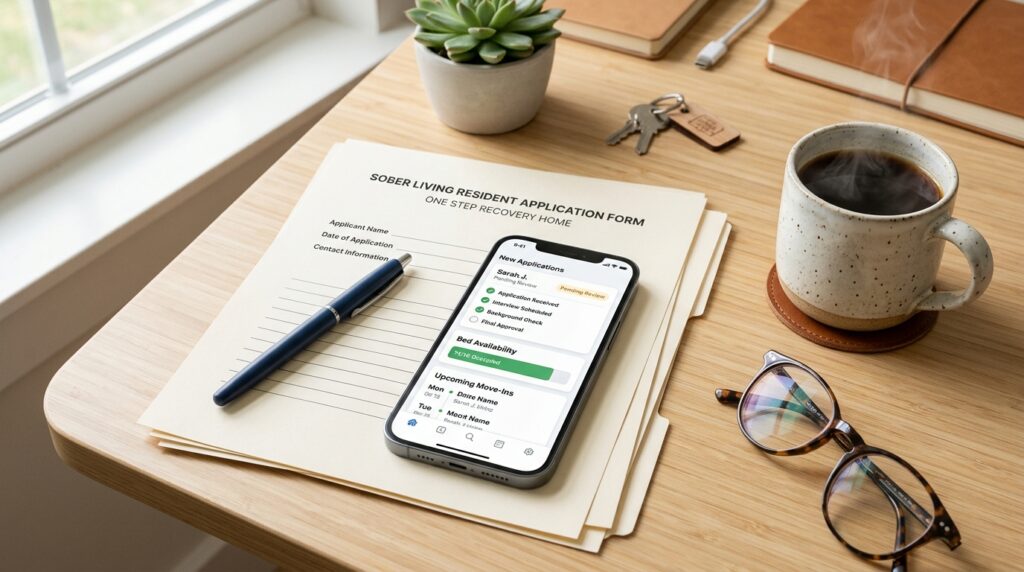
Digital documentation works best when it is centralized and easy to access. One Step Software includes a documents tab within each resident profile, along with shared document folders for the sober living home. This allows operators and house managers to store and manage house rules, intake forms, drug test logs, meeting notes, and incident reports in one secure place, rather than across binders, emails, or shared drives.
- All resident records accessible in one secure, centralized location
- Intake paperwork completed before move-in, not chased afterward
- Drug test logs, incident reports, and meeting notes stored consistently across shifts
- Operators can demonstrate compliance quickly for inspections or audits
When documentation lives in a single system, errors are reduced, records are easier to maintain, and consistency improves across staff shifts and multiple houses. Staff spend less time searching for paperwork and more time supporting residents, while operators have confidence that records are complete, current, and accessible when needed.
To see how other operators are running structured, accountable homes, see our guide on what makes a great sober living home—and how documentation plays a central role.
Does Reducing Staff Burnout Actually Improve Recovery Outcomes?
Staff burnout is a hidden risk in sober living homes. Overworked house managers are more likely to miss warning signs, apply rules inconsistently, or disengage emotionally. Research across healthcare and social services consistently links burnout to poorer recovery outcomes. An NIH-indexed review published in JAMA Internal Medicine found that burned-out staff were significantly more likely to make safety-related errors and deliver lower-quality care.
In recovery housing, this can show up as missed accountability steps, uneven enforcement, and reduced presence with residents. Technology that reduces repetitive tasks allows staff to focus on people, not paperwork. Automated reminders, centralized records, and mobile tools lower the mental load on house managers. Learn more about why house managers love using One Step Software to manage their daily workload.
- Automated curfew and meeting reminders free staff from repetitive follow-ups
- Centralized records eliminate time spent searching across binders, emails, and drives
- Mobile tools let house managers stay informed without being physically present at all times
- Less administrative burden means more meaningful time with residents
Does Technology Replace Human Care in Recovery Housing?
Technology does not keep people sober. People, structure, and support do. But technology can strengthen the systems that make recovery possible.
Public health research increasingly recognizes digital tools as effective complements to traditional recovery support, particularly when they are designed for specific environments rather than adapted from generic healthcare systems, according to the Substance Abuse and Mental Health Services Administration. The National Institute on Drug Abuse notes that mobile-based recovery tools are among the most scalable and cost-effective supports available to recovery housing operators today.
In sober living homes, this means technology built around real workflows, not property management software repurposed for recovery. When technology aligns with recovery values, it fades into the background and supports the work already happening in the house.
What Does Technology-Supported Recovery Look Like in Practice?
In a sober living home, technology should support the work already happening, not change the culture of the house or add more to manage. Here is what that looks like day to day:
- Residents check into AA or NA meetings from their phones using geolocation—no paper slips required
- Curfews are logged automatically, without late-night staff texts or manual entries
- Drug tests, house meetings, and incident notes live in one centralized system
- Intake paperwork is completed before move-in, not chased later
- House managers spend less time tracking and more time supporting residents
- Mood trends are visible at a glance so staff can intervene early when a resident is struggling
That is the role One Step Software is built to play.
One Step brings accountability, documentation, communication, and structure into a single system designed specifically for sober living homes. Operators can see what is happening without hovering. House managers have clear, simple tools. Residents experience consistent expectations that feel fair, not reactive.
If you want to see how this could work in your own house, you can book a short demo today. It is a walkthrough with a chance to see if One Step Software fits the way your operation runs.
Key Takeaways
- Technology reinforces structure, consistency, and accountability—core drivers of long-term recovery stability
- Verified digital meeting check-ins reduce gaps and false reporting without added confrontation
- Mood tracking and journaling tools help residents recognize emotional triggers before relapse occurs
- In-app peer messaging keeps connection organized and aligned with house expectations
- Centralized digital documentation protects both residents and operators
- Reducing staff burnout through automation directly improves care quality and resident outcomes
- A smartphone-based recovery support tool reduced risky drinking days by nearly 50% in a JAMA clinical trial
FAQs
Can technology really improve recovery outcomes in sober living homes?
Yes. Technology improves recovery outcomes by reinforcing structure and consistency. Tools like verified meeting check-ins, mood tracking, and centralized documentation reduce gaps in accountability and help staff respond earlier when residents need support. The goal is not surveillance—it is clarity, fairness, and follow-through, which research consistently links to stronger recovery stability. A JAMA-published clinical trial found a smartphone-based recovery tool reduced risky drinking days by nearly 50%.
Does using technology feel intrusive for residents?
When implemented correctly, it should not. Recovery-focused technology works best when expectations are clear and applied consistently. Features like geolocation meeting check-ins or mood tracking remove guesswork and reduce confrontation. Residents know the rules upfront, and accountability feels neutral rather than personal.
Can technology replace house managers or peer support?
No. Technology does not keep people sober. People do. The role of technology is to support house managers and residents by reducing administrative work, organizing information, and reinforcing routines. Human connection, peer accountability, and support remain central to recovery.
How can operators use data without crossing privacy boundaries?
Most recovery-focused systems are designed to surface trends, not personal details. For example, mood tracking can show overall patterns without exposing private journal entries. This allows staff to identify when additional support may be needed while still respecting resident privacy and dignity.
Is recovery-focused software only useful for larger sober living operators?
No. Smaller homes often benefit just as much, if not more. Operators managing one or two houses typically have fewer staff and less time. Centralizing documentation, accountability, and communication can reduce burnout early and make it easier to stay organized as the program grows.
What features should I look for in sober living software?
Look for tools built specifically for recovery housing, not repurposed property management software. Key features include geolocation meeting check-ins, resident mood tracking, centralized documentation, in-app messaging, automated reminders, and drug test logging. One Step Software includes all of these in a single platform designed for sober living homes of any size.