
Sober Living and the Coronavirus – Covid 19
Over the last week it has become very real for us that we need to be ready to take steps to avoid the spread of the current Coronavirus also known as Covid 19. The NBA doesn’t suspend a season for no reason right? Something very serious must be happening.
The spread of a new virus is something that most of us in the United States have never been through before. For most of us this is new territory and we are in a steep learning curve because we are being required to learn to behave differently and very quickly.
Luckily, time in recovery prepares us for learning curves and behavior changes. We have everything we need to take a clear and authentic look at what we are up against and do what needs to get done to protect ourselves and our communities.
One of the challenges of sober living is getting everyone onboard with the behavior changes that need to take place in households in order to protect inhabitants. Below are some resources and recommendations that we have gathered to help out.
The Big Question:
How can sober living homes and sobriety communities reduce the spread of Covid 19 in their facilities and living spaces?
1. Keep Calm and Recover On
It’s important that we carry on as much as possible with the practices that have helped us achieve our current success. In this letter recently posted by Alcoholics Anonymous on AA.org there are some general guidelines for addressing the possibility of Coronavirus (aka Covid 19) spread during meetings. The letter states:
“Some groups have discussed making changes to customs at their meetings. Some examples have included: avoiding shaking hands and handholding; making sure meeting hospitality tables are sanitary; or suspending food hospitality for the time being. Regardless of group decisions, each individual is responsible for their own health decisions.
Some groups have considered contingency plans in case the group is temporarily unable to meet in person. Plans have included: creating contact lists and keeping in touch by phone, email or social media; meeting by phone or online. Providing members information for the A.A. Online Intergroup (www.aa-intergroup.org) may serve as an additional helpful resource. If a group isn’t holding its regular meetings, they may want to communicate this to local A.A. resources, such as the district, area and intergroup or central office.”
The idea of making changes to the practices and customs that have gotten us where we are is a big deal. It is worth looking at and giving serious attention to right now while we are working on stopping the spread of a new virus that puts many people in real danger.
The most important thing to remember is that we know what to do to evolve and to continue to grow in our recovery, especially through change. And we will strengthen our communities while we do it.
2. Preventing the Spread of the Virus in Sober Living environments.
To prevent the spread of any virus including Covid 19 we very simply need to reduce or eliminate contact with the virus. I know, it sounds simple but is it really?
We all have a sense of how we end up making contact with a virus.
- An infected person coughs or sneezes near us and we breathe it in.
- An infected person coughs or sneezes on an object (could be their hand), that we eventually touch, and then we touch our food, face, mouth, nose, or eyes.
This is especially challenging in community environments like sober living and recovery meetings where long held practices and customs would help the Covid 19 virus spread.
An ideal practice would be that people who are not feeling well stay home from meetings. How is this going to work for someone who has a commitment to 30 meetings in 30 days? Do residents have access to computers and the internet? Can they attend online meetings when needed?
This link is for AA Online Intergroup online meeting directory
Here is a list for online meetings from 12step.org
It’s still possible to get to 30 meetings in 30 days even if participants aren’t leaving the house.
Another challenge is that experts are recommending the following for highly infected or high risk communities to consider:
- Create social distancing as needed
- Self isolation as needed
- Self quarantine as needed
These are not conducive to the practices, like meetings and fitness, that many have created to help maintain their sobriety.
The Substance Abuse and Mental Health Services Administration (AKA SAMHSA) has posted
a very detailed article about social distancing, self isolation, and self quarantine. In some cases you may find that residents need to practice self-isolation and/or self-quarantine in your recovery home or facility.
SAMHSA has a Disaster Distress Hotline number that may be helpful during this time. It is 1-800-985-5990. It may be a good idea to have the number available.
“The Disaster Distress Helpline, 1-800-985-5990, is a 24/7, 365-day-a-year, national hotline dedicated to providing immediate crisis counseling for people who are experiencing emotional distress related to any natural or human-caused disaster. This toll-free, multilingual, and confidential crisis support service is available to all residents in the United States and its territories. Stress, anxiety, and other depression-like symptoms are common reactions after a disaster. Call 1-800-985-5990 or text TalkWithUs to 66746 to connect with a trained crisis counselor.”
(Extra Tip: If you will be using printed copies to inform your residents about the Covid 19 situation it may be important that each resident gets their own copy to reduce the potential for virus spread on paper.)
It’s important to remember that we are taking these steps temporarily to reduce the spread long enough and well enough that we don’t overwhelm our medical system so people who are infected and in serious condition can continue to get the medical health that they need. Some experts are calling this Flattening the Curve. We are going to be extra careful for a while and hopefully things will get better faster and we can return to normal.
3. Hand-washing is very very very very important
Whether a person is or is not showing any symptoms it is possible that they can be spreading Covid 19.
Handwashing is an essential way to stop this. This Webmd article explains how handwashing is so effective. In the article Elizabeth Scott PhD (Co-director for the Simmons University Center for Hygiene and Health in the Home and Community) says:
“You can’t necessarily control what you touch. You can’t control who else touches it. But you can look after your own hands”.
This resonates with what the aa.org article above says about being responsible for our own well being.
So…. it is not so called “panic-buying” for your sober living home to have 5 or 10 back up bottles of hand soap for each bathroom and your kitchen. Hand washing is essential to stopping the spread of a virus inside a home. It is important that you don’t run out. Even if you buy too much it will get used eventually. Soap is more effective than hand sanitizer. Do not use hand sanitizer in the place of soap. Consider keeping some extra bottles of lotion around to help with dry hands due to extra washing. Small amounts of olive oil or coconut oil will do in a pinch.
Here are the World Health Organization’s Guidelines for Handwashing:
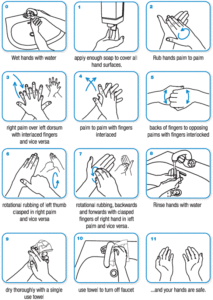
(Right click or double click and save image to computer to print from computer)
Tip: If you print these out consider making one for each client or fixing them to the bathroom and kitchen walls. Paper is one of those things that we pass around that can carry a virus from one person to another unsuspectedly.
4. Clean and disinfect regularly
This article from the Center for Disease Control gives instructions for more intense cleaning and disinfecting regiments for when residents are self-quarantining or self-isolating due to contact with others who are known to be infected or are concerned they may be showing symptoms.
5. What are the symptoms and how do we know when someone needs to see a Dr?
People who are in close quarters in their recovery residences may want to be aware of what to look for. We are all going to cough or sneeze once in a while like we always have. It’s going to take extra communication and compassion with each other to figure out how to care for ourselves and discern normal colds and allergies from Covid 19 infection. This can be a really intense conversation between housemates. It’s time to put our best compassion and communication practices to work. We can do this! This article is about steps to take when someone is sick and can help keep the peace in our shared spaces.
Dry cough, fever, and shortness of breath seem to be distinguishing characteristics of Covid 19 aka Coronavirus. These things can be an emergency for people with known or underlying health conditions. If they are severe enough they can be an emergency for anyone. Do the research and use your best judgement.
6. Use all the online resources available but be careful because not everything on the internet is true or good.
Truthfully, we are in a position that we have never been in before and it can be scary. If being informed helps you feel like you are doing your best work there are many credible resources available to help.
On Twitter and Reddit, for example, medical experts are communicating with the public. In Twitter you can search for #coronavirus or #covid19 and find medical experts. In Reddit you can search for Covid 19 or Coronavirus and find subreddits full of scientific documents and data lists coming in from all over the world. We are truly equipped to solve this quickly.
Be warned – more exposure to information can make it all feel much more real and intense.
This is our first modern pandemic. It’s a big deal and it is totally appropriate to be anxious about our well being and the well being of our communities and loved ones. I take comfort in infectious disease expert Helen Branswell’s post that she pinned at the top of her twitter page.
At the end of her tweet Helen says:
“But please know this: we are going to get through this. Really.”