
Key Takeaways
- Michigan does not require a state license for sober living homes that provide only housing and peer support without clinical services. A license is required only when a home provides substance use disorder treatment under Michigan Part 62 administrative rules.
- The Michigan Association of Recovery Residences (MARR) is Michigan’s official NARR affiliate and the state’s voluntary certification body for recovery housing. MARR certifies homes across all four NARR levels using NARR Standards 3.0.
- Michigan state law mandates that state-funded agencies refer clients only to certified recovery homes. This legislative requirement makes MARR certification practically essential for operators who serve publicly funded residents, even though certification itself is not legally required to operate.
- The Michigan State Housing Development Authority (MSHDA) requires current MARR or CARF certification as a condition for Recovery Housing Investment Program grants. A December 2025 MDHHS announcement of a $37.5 million investment targeting 3,467 new recovery housing beds by 2028 makes access to that funding increasingly significant.
- One Step Software helps Michigan operators maintain the documentation, operational consistency, and incident records that MARR certification and state funding programs expect.
Michigan does not follow the same path as Virginia, where certification became mandatory in 2025, or California, where the licensing line turns on whether clinical services are delivered. Michigan’s framework is voluntary at the state level, but that description understates how much certification actually matters in practice. For operators who want referrals from treatment centers, contracts with state-funded programs, or access to Michigan’s expanding recovery housing funding, MARR certification has become a functional requirement even without a legal mandate.
Understanding what Michigan actually requires, and what it effectively requires, gives operators a clearer picture of what they need to do before opening and what they need to maintain once they are operating.
The Licensing Distinction in Michigan
Michigan’s licensing framework for substance use disorder services is governed by Part 62 of the Public Health Code and related administrative rules under the Michigan Licensing and Regulatory Affairs bureau (LARA). A residential setting that provides substance use disorder treatment or rehabilitation services on-site is classified as a licensed facility under this framework.
A sober living home that provides housing and peer support, without delivering counseling, group therapy, formal treatment planning, or withdrawal management services, sits outside that licensing requirement. The line is the same one that applies in California and most other states: housing is not treatment, and peer support is not clinical care.
That distinction matters for how operators structure their programs. House meetings focused on chores, house rules, accountability, and mutual peer support are on the right side of the line. Bringing in a counselor to facilitate structured group therapy sessions as part of the residential program, or advertising clinical programming as a feature of the home, moves toward the licensed category. Michigan operators who are uncertain about where their specific services fall should consult with a legal or regulatory professional before offering any service that could be interpreted as clinical.
Read also: Compliance Guide for Sober Living Homes – One Step
What MARR Certification Requires
MARR was established in 2018 as Michigan’s NARR affiliate and uses NARR Standards 3.0 to certify homes at all four levels of support. Most independent operators pursue Level II or Level III certification, which reflects a monitored or supervised environment without clinical licensing requirements.
Before applying, a home must have been operational for at least 30 days with at least one resident. The operator must also complete the required MARR and NARR training, which covers best practices, ethics, and the social model of recovery. As of December 2025, this training costs $2,000 for non-certified operators, with the fee applied toward the certification application if the operator proceeds.
The certification process involves submitting an application through MARR’s portal, providing organizational documentation including written policies and procedures, house rules, resident agreements, and a code of ethics, securing commercial general liability insurance that names MARR as an additional insured party, completing a site inspection, and meeting NARR Standard 3.0 requirements across governance, physical environment, resident rights, and operations.
MARR issues a full certification valid for one year when all standards are met. Conditional approval may be granted when minor deficiencies exist, with a correction period typically of 30 days. Annual renewal requires an updated background check, proof of current insurance, documentation of any operational changes, and a renewal inspection. MARR can conduct random site visits at any time during the certification period.
Certified homes are listed in MARR’s public directory, which treatment centers, courts, and Prepaid Inpatient Health Plans use when making referrals. Being on that list is one of the most direct ways a Michigan operator builds referral volume.
The Funding Picture
The practical importance of MARR certification in Michigan is closely tied to where recovery housing funding is going. MSHDA’s Recovery Housing Investment Program requires current MARR or CARF certification as a mandatory condition for grant eligibility. The December 2025 announcement of a $37.5 million MDHHS investment in recovery housing, targeting nearly 3,500 new beds by 2028, signals that public funding for recovery housing in Michigan is expanding significantly.
Operators who are not certified are excluded from that funding pipeline. Given the scale of investment being directed toward recovery housing in Michigan, that exclusion has a meaningful financial impact for homes trying to grow beyond private-pay revenue.
Beyond state housing funds, Michigan Prepaid Inpatient Health Plans, opioid settlement funds directed toward recovery housing, and county-level behavioral health contracts all flow preferentially or exclusively to certified homes. Building the certification infrastructure now positions operators to access those streams as they become available in their local market.
Learn more: Government grants for sober living homes – One Step
Local Requirements That Apply Regardless of Certification
State-level certification does not replace local compliance obligations in Michigan. Sober living operators must meet local zoning rules in the city or township where the home is located. LARA’s administrative rule R 325.1343 requires even unlicensed recovery housing to comply with local governmental requirements for residential settings, meaning operators face inspections by municipal building departments and fire marshals regardless of certification status.
Michigan has no state-imposed occupancy limits for recovery housing, but local housing and safety codes set practical limits through square footage and room capacity requirements. Operators should verify local zoning and occupancy rules before selecting a property and should have a plan for reasonable accommodation requests if a local ordinance creates barriers to operation.
Federal Fair Housing Act and ADA protections apply to Michigan recovery housing, classifying individuals in recovery from substance use disorders as a protected class. In 2023, the city of Howell settled a lawsuit after attempting to restrict sober living homes from residential areas, with the Fair Housing Center of Southeast Michigan successfully challenging the ordinance. These protections are real and have been upheld in Michigan courts, but they require operators to document their program clearly as non-clinical recovery housing to maintain eligibility for those protections.
What This Looks Like in Practice
Michigan’s framework gives operators more flexibility than Virginia’s mandatory certification model, but that flexibility comes with a responsibility to self-organize. Without a hard legal requirement, the documentation and operational practices that certification demands can be deprioritized. Operators who deprioritize them find themselves excluded from funding, off the referral lists that generate consistent occupancy, and unprepared when a quality concern is raised by a resident, neighbor, or partner.
The operators in Michigan with stable occupancy and growing programs are almost universally MARR-certified. They have written policies, consistent resident documentation, house rules that are applied uniformly, and accountability systems that produce the records that referral partners expect to see.
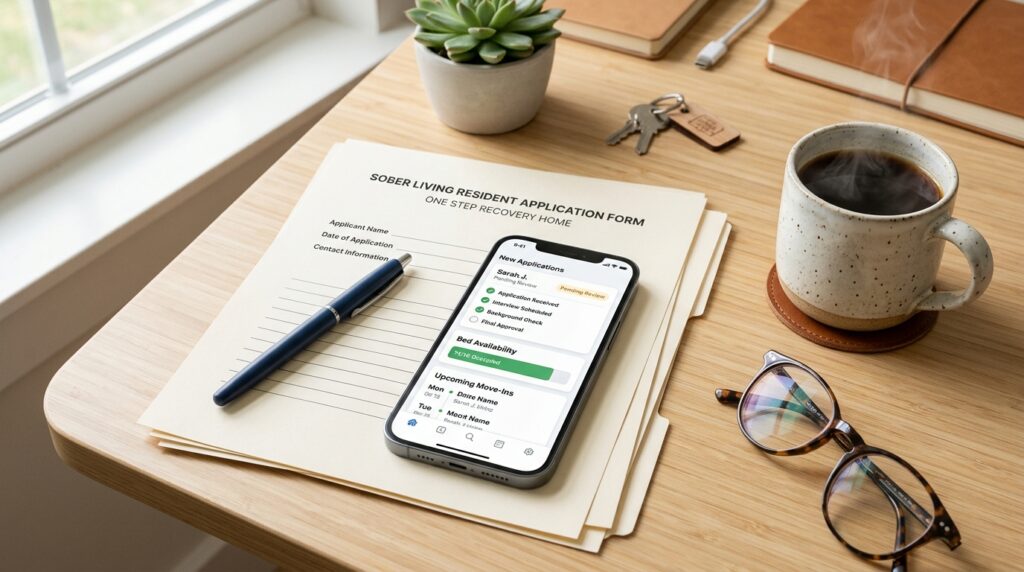
One Step Software gives Michigan operators the infrastructure to build and maintain that documentation from the start. Centralized resident records, digital intake, incident logging, and drug testing documentation create the operational foundation that MARR certification requires and that Michigan’s expanding public funding programs will continue to expect.
FAQs
Does a Michigan sober living home need a state license?
Not unless it provides substance use disorder treatment services. Homes that provide only housing and peer support are generally exempt from licensing requirements under Michigan Part 62. The requirement for a license applies when a residential setting delivers counseling, treatment planning, or rehabilitation services on-site.
Is MARR certification required in Michigan?
MARR certification is voluntary in terms of state law. However, Michigan law requires state-funded agencies to refer clients only to certified homes, and MSHDA requires current MARR or CARF certification for all Recovery Housing Investment Program grants. For operators building referral relationships with treatment centers, courts, or state-funded programs, certification is effectively necessary.
How long does MARR certification take?
The timeline depends on how organized the operator’s documentation is before applying. Completing the required training and assembling policies, resident agreements, and insurance takes most operators several weeks. The site inspection and review process adds additional time. Operators who have their documentation prepared in advance move through the process faster.
What does MARR certification cost?
As of December 2025, the required MARR and NARR training costs $2,000 for non-certified operators, with the fee credited toward the application if the operator proceeds to certification. Additional costs include application fees, annual per-site renewal fees, and a $100 fee for follow-up inspections if in-person rechecks are needed after corrections.
What happens if a Michigan sober living home operates without certification?
An uncertified home is not operating illegally, provided it is not delivering clinical services that require a license under Part 62. However, it is excluded from state-funded referrals, MSHDA grant programs, and the MARR public directory used by treatment centers and courts. It also lacks the accountability framework that protects operators and residents when disputes or incidents arise. For most operators with growth ambitions in Michigan, operating without certification is not a sustainable long-term position.