

Key Takeaways
- SAMHSA defines Recovery Community Organizations as independent, nonprofit organizations led and governed by representatives of local communities of recovery, with grant eligibility tied to continued proof of that governance and compliance with reporting requirements.
- A 2021 study published in Drug and Alcohol Dependence, analyzing data from 3,459 participants across 20 RCOs, found that peer-based recovery support services delivered through these organizations produced positive improvements in individual recovery capital.
- A 2022 narrative review published in the Journal of Addiction Medicine identified sustainable reimbursement, formalized supervision structures, and strategies for addressing burnout as critical considerations for peer recovery support programs, all of which depend on organized operational systems.
- SAMHSA’s peer support guidance notes that peer support workers help people become and stay engaged in the recovery process, extending the reach of recovery support beyond clinical settings into everyday environments.
- Software does not deliver peer support. But it determines whether the organization behind that support can sustain itself, stay funded, and demonstrate its value over time.
Recovery Community Organizations operate at the intersection of lived experience and formal service delivery, and that position creates an unusual set of operational demands. On one side, they are running peer-based programs built on trust, flexibility, and human connection. On the other hand, they are accountable to grant funders, state agencies, and reporting requirements that demand consistent data, measurable outcomes, and organized documentation.
Most RCOs start with tools that were not built for this work. Spreadsheets track participant contacts. Email threads hold case notes. Grant reporting gets assembled manually at the end of each quarter. It holds together until it does not, and when it breaks, it usually breaks at the worst possible time, during a funding renewal, a site visit, or a staff transition.
The question of what software works best for an RCO is really a question about what helps an organization carry out its mission without drowning its staff in administrative overhead.
What Makes RCO Operations Distinct
RCOs are not sober living homes, treatment centers, or case management agencies, though they often work alongside all of those. SAMHSA’s Recovery Community Services Program defines RCOs as organizations that must be controlled and managed by members of the addiction recovery community, distinguishing them from organizations that deliver services to but are not governed by people in recovery.
That governance requirement has practical implications. Staff and volunteers are often themselves in recovery. Programs are built around peer relationships rather than clinical hierarchies. The work is relational, and outcomes are sometimes difficult to capture in the structured data formats that funders require.
A 2021 qualitative study on peer support workers published in PMC described this tension directly. Peer support workers reported increasing pressure to produce measurable outcomes for grant funders and insurance companies, but felt those demands contradicted the informal, relationship-based nature of the work. As one worker in the study put it: “I get it on their end, they want outcomes to show that the money is worth spending. It’s really hard to quantify quality of life.”
Good software for an RCO acknowledges that tension. It should make data collection feel like a natural part of service delivery rather than a separate administrative burden, so staff can focus on the relationships that actually move the needle.
The Reporting and Compliance Problem
For RCOs receiving SAMHSA grants, reporting is not optional or informal. SAMHSA’s grant management guidance requires grantees to submit timely and accurate performance data throughout the life of the award. Annual continuation of funding depends on demonstrated progress toward project goals and objectives, not just on program activity. Organizations that cannot produce reliable documentation risk both their funding and their credibility with referring partners.
The SAMHSA SPARS system is the federal data entry and reporting platform that grantees use to submit performance data. Organizations with disorganized internal records find this process painful every reporting cycle, because SPARS requires specific data fields that need to have been tracked consistently throughout the grant period, not reconstructed at the end.
A 2021 study examining peer-based recovery support services at RCOs used data from RecoveryLink, an electronic recovery record platform adopted by 20 RCOs, to analyze participant outcomes across 3,459 individuals. The study noted that this kind of platform allowed organizations to systematically collect standardized intake, engagement, and outcomes data, which made the research possible and would similarly make grant reporting more reliable. Organizations without such a system are collecting the same data manually, if at all.
The compliance picture matters beyond federal grants, too. Many state-funded programs, opioid settlement initiatives, and Medicaid-reimbursable recovery support services require documentation of services delivered, participant demographics, and engagement duration. An RCO that cannot produce this data consistently will find itself locked out of funding streams that are increasingly available to organizations that can.
What Peer Workers Actually Need from Operational Tools
The staff running peer recovery programs have different needs from the administrative staff filing reports. They are often working in community settings, meeting participants where they are, and managing relationships across a caseload that can change week to week. Software that adds friction to their workflow creates the same problem that clinical EHRs create in sober living homes: the system gets ignored.
The 2022 narrative review in the Journal of Addiction Medicine on peer recovery support services across settings identified several challenges that technology can directly address, including the need for formalized supervision structures, sustainable approaches to service delivery, and strategies to reduce burnout among peer workers. When peer staff do not have clear tools for logging contacts, tracking participant progress, and communicating with supervisors, those supervision structures are harder to maintain.
SAMHSA’s core competencies for peer workers describe peer recovery support as person-centered, voluntary, and relationship-focused. None of that is undermined by good documentation. What it does require is that documentation tools be simple enough to use without becoming the focus of the interaction. A peer worker who spends twenty minutes after each participant contact entering data into a complicated system will either stop documenting or stop spending time with participants.
Participant Engagement and Tracking
RCOs often serve participants across long periods of time, sometimes years, and across multiple types of support: recovery coaching, housing navigation, employment support, connection to treatment, and peer-led group programming. Tracking that engagement in a way that reflects the participant’s journey, rather than just counting service units, requires a system with flexibility.
The 2021 Drug and Alcohol Dependence study found that participants engaged in peer services at RCOs reported low frequency of negative health events, including recurrence of use and emergency department visits, while engaged with the organization. Demonstrating that kind of outcome to funders requires longitudinal tracking of participant status, not just intake data.
Organizations that can show a participant’s recovery capital at intake and at regular intervals, track what services they received and how frequently, and document referrals made, and outcomes of those referrals are in a fundamentally stronger position when it comes to funding renewals, grant applications, and community partnerships. That data does not generate itself. It requires a system that staff will actually use consistently.
What Good Software for an RCO Needs to Do
The operational needs of an RCO are different from those of a sober living home, though they often overlap where both serve people in early recovery. Some of the core requirements are consistent across both: centralized participant records, intake documentation, communication tools, and reporting visibility. The differences come in how the work is structured.
Participant intake and enrollment tracking need to be simple enough for peer workers to complete without clinical training. Engagement logging should capture the type and frequency of contact without requiring lengthy narrative entries for every interaction. Referral tracking matters because a significant portion of RCO work involves connecting participants to outside services, and organizations need to know whether those referrals resulted in contact. Group programming and event management features are useful for RCOs running recovery community centers or peer-led programming. And grant reporting support, whether through exportable data or built-in outcome tracking fields, reduces the end-of-quarter scramble that most RCOs without dedicated data staff experience every funding cycle.
The gap for many RCOs is not access to software but access to software built around how peer recovery programs actually work, rather than adapted from clinical, property management, or generic nonprofit tools.
What This Looks Like in Practice
In practice, an RCO running on the right software spends less time on administration and more time on community. Peer workers log contacts in minutes. Supervisors can see caseload activity without asking for manual reports. Intake is completed digitally and stored where the whole team can access it. When a grant report is due, the data is already organized.
Program leadership can see which services are being used, which participants have gone quiet, and where referrals are leading. That visibility makes it easier to manage staff, demonstrate impact to funders, and make decisions about where to invest program resources.
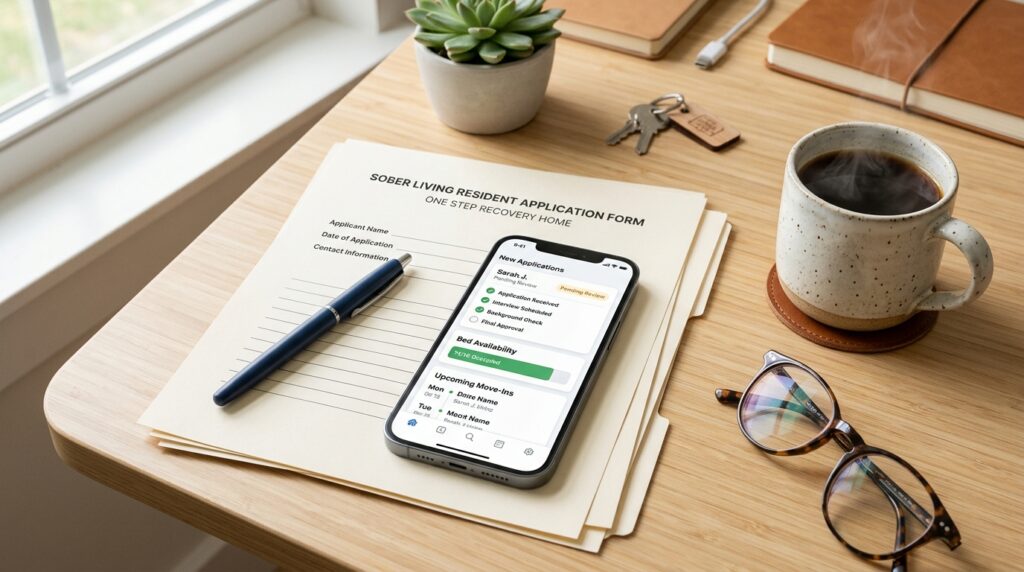
That is the role One Step Software is built to support. Designed for recovery housing and recovery support programs rather than clinical settings, One Step centralizes participant management, documentation, communication, and reporting in one platform. For RCOs that also operate or partner with sober living homes, that integration means one system across the continuum rather than separate tools for each program type.
FAQs
What is a Recovery Community Organization?
SAMHSA defines RCOs as independent, nonprofit organizations led and governed by representatives of local communities of recovery. They deliver peer recovery support services to people with substance use disorders or co-occurring conditions, and are distinguished from other organizations by the requirement that they be controlled and managed by people in recovery themselves.
Why do RCOs need specialized software rather than general nonprofit tools?
General nonprofit tools can manage donor records and event registrations, but they were not built around participant engagement tracking, peer support documentation, or the specific data fields that SAMHSA and state grant programs require. RCOs that try to force their operations into general-purpose platforms spend significant time bridging gaps manually, which increases administrative burden on staff who are already stretched.
How does software help with SAMHSA grant reporting?
SAMHSA requires grantees to report performance data consistently throughout the grant period. Organizations with centralized intake and engagement records can pull that data efficiently at reporting time. Organizations without organized records reconstruct them under pressure, which produces less accurate reports and more staff stress. Platforms that track the right fields from the start make compliance a routine task rather than a quarterly emergency.
Can RCO software support both peer support programs and sober living operations?
Some platforms are designed to work across both. For organizations that operate a recovery community center alongside recovery housing, having one system rather than two reduces the data fragmentation that makes oversight difficult and reporting inconsistent. It also makes it easier to track participants who move between programs.
What should RCOs prioritize when evaluating software?
Ease of use for peer workers should come first. If the people doing the direct service work cannot navigate the system confidently, data quality will suffer regardless of what the platform is capable of. Beyond that, look at whether the system supports the specific reporting requirements of your grant programs, whether participant records are longitudinal and accessible, and whether the platform can scale as the organization grows.