

Founder, One Step Software — Expert in Sober Living Operations & Recovery Technology
The Best Software for Sober Living Homes: What to Look for and Why It Matters
Key Takeaways
- Most sober living homes outgrow spreadsheets and paper files faster than operators expect – the problems show up in staff accountability, resident documentation, and compliance readiness.
- SAMHSA’s 2023 Best Practices for Recovery Housing recommends that all recovery housing entities pursue certification, describing it as a direct remedy for inconsistent and unethical operations.
- A 2025 systematic review in Frontiers in Psychiatry found that recovery housing outperformed standard care on abstinence, employment, and criminal outcomes across follow-up periods of six to twenty-four months.
- Research from the Agency for Healthcare Research and Quality consistently shows that when technology does not match how an organization actually operates, it increases burden rather than reducing it.
- The right software does not replace the human work of recovery housing. It creates the conditions for that work to stay consistent.
Most sober living operators do not go looking for software. They start with what is available – a shared spreadsheet, a folder of PDFs, a group text thread – and they make it work until they cannot. Then a staff member leaves and takes institutional knowledge with them. Or a certifying body asks for documentation that no one can locate. Or a second house opens, and the system that barely worked for one house collapses entirely under two.
That is the practical context behind the question of what software works best for sober living homes. It is not really about technology. It is about what breaks first when operations get complicated, and what tools reduce that risk without creating a new layer of burden that nobody has time for.
Why Generic Software Does Not Hold Up in Recovery Housing
The first software many operators reach for is a property management tool. The logic seems reasonable – sober living homes collect rent, track occupancy, and manage move-ins. The problem is that sober living is not a rental operation. Resident behavioral agreements, drug testing logs, incident documentation, and discharge planning are not features that property management platforms were built to support. Operators who go this route usually end up running two disconnected systems, manually bridging the gap between them.
Clinical software creates the opposite problem. Electronic health records built for IOP programs and treatment centers carry documentation requirements and pricing structures that reflect a licensed clinical environment. For a Level II sober living home with a house manager and a small team, that kind of infrastructure is more than the operation can reasonably absorb.
Research from the NCBI Bookshelf’s chapter on organizational workflow and patient safety puts it directly: “When a new health IT system fails to accommodate the real workflows of an organization, interacting with the technology becomes a greater burden on the organization than is required.” The Agency for Healthcare Research and Quality reinforces this, noting that successful health IT implementation depends as much on matching organizational culture and work process as it does on the technology itself.
Purpose-built sober living software sits between those two options – designed around intake, house rules, accountability tracking, resident records, and operational visibility across one or more houses.
What the Research Says About Structure and Outcomes
Software choices in recovery housing are not just administrative decisions. They have a direct bearing on whether a home can maintain the kind of structure that research links to better resident outcomes.
A 2025 systematic review published in Frontiers in Psychiatry, drawing on randomized controlled trials and quasi-experimental studies, found that recovery housing consistently outperformed standard continuing care on abstinence rates, income, employment, and criminal charges across follow-up periods ranging from six to twenty-four months. The review also found that recovery housing outperformed other residential settings in reducing alcohol use and days of substance use.
SAMHSA’s 2023 Best Practices for Recovery Housing describes what makes those environments effective: “Recovery houses are safe, healthy, family-like, substance-free living environments that support individuals in recovery from addiction. While recovery residences vary widely in structure, all are centered on peer support and connection to services that promote long-term recovery.”
A 2024 study in Community Mental Health Journal examining quality and outcome measures across recovery housing found that operational documentation remained highly variable across homes – even among those operating under NARR standards. That variability is an operational gap that the right software directly addresses.
NARR Standards and What They Require Operationally
SAMHSA’s 2023 guidance recommends that all recovery housing entities be certified, calling it “one noted remedy to address unethical and illegal practices in recovery housing.” The National Alliance for Recovery Residences, whose standards are now used as the certification basis in 36 states, builds its framework across four domains: physical environment, recovery support, operations, and community.
The operational domain is where software becomes directly relevant. NARR requires documented policies and procedures, resident rights documentation, incident reporting processes, staff training records, and consistent application of house rules. As NARR notes, certified residences promote “a level of consistency across houses that has not been previously seen or understood by communities, decision-makers, funders, and researchers.” That consistency does not happen without systems to sustain it.
For multi-house operators, the pressure compounds. Each location needs its own records while operating under the same policies. Referral partners – treatment providers, courts, probation departments – increasingly expect certified homes that can demonstrate operational credibility. The documentation that supports certification is also the documentation that builds those relationships.
What Good Sober Living Software Actually Needs to Do
The clearest way to evaluate software is to map it against the friction points that actually slow operations down or create compliance risk – not the features listed on a pricing page.
Intake and onboarding are where most homes feel the gap first. Residents arrive during stressful transitions. Getting complete signed agreements, emergency contacts, medication records, and house rule acknowledgments done on paper at that moment creates consistent gaps. Software that allows intake to be completed digitally before arrival – with reminders for missing items – removes a recurring source of friction at the worst possible time.
Accountability tracking is the second high-friction area. Drug testing logs, curfew records, meeting attendance, and behavioral notes accumulate quickly. When they live across notebooks, email chains, and text threads, staff spend time reconstructing history instead of managing the present. Centralized documentation means a complete resident record is available when a discharge needs to be documented, a question comes up mid-residency, or a referral partner asks about program outcomes.
Communication and operational visibility round out the core needs. For operators managing more than one house, knowing who is in each house, which beds are available, which documentation is overdue, and which incidents have been logged requires real-time data – not a manual phone check.
The Staff Workload Problem
One factor that gets underweighted when evaluating software is what it actually does to staff. House managers often manage a full household with limited administrative support. When the tools they are given do not match how they work, they adapt – usually by doing less documentation, not more.
Research published in the Journal of General Internal Medicine studying digital systems in small community-based settings found that well-matched platforms reduced work burden for administrative and support staff by improving how they record information and communicate across the team. The consistent finding across that literature is that the benefit only materializes when the system fits the workflow.
As AHRQ’s research on health IT implementation found, when systems create mismatches with established work processes, they generate more interruptions, more off-hours work activity, and more task-switching – not less. For sober living homes, ease of use is not a secondary consideration. A system a house manager cannot navigate confidently will not be used consistently, and inconsistent use defeats the purpose of having a system at all.
What This Looks Like in Practice
In practice, the right platform creates operational consistency that runs in the background. Residents complete intake agreements before they arrive. Staff review documentation ahead of move-in. House rules are acknowledged and timestamped. Drug testing and incident logs live in the same system as resident records. When a resident exits, the discharge record is already there.
Staff spend less time on paperwork and more time on the house. When a certifying body asks for documentation, it is accessible. When a referral partner wants to understand the program, there is data to share. When a second house opens, the systems in place extend to it.
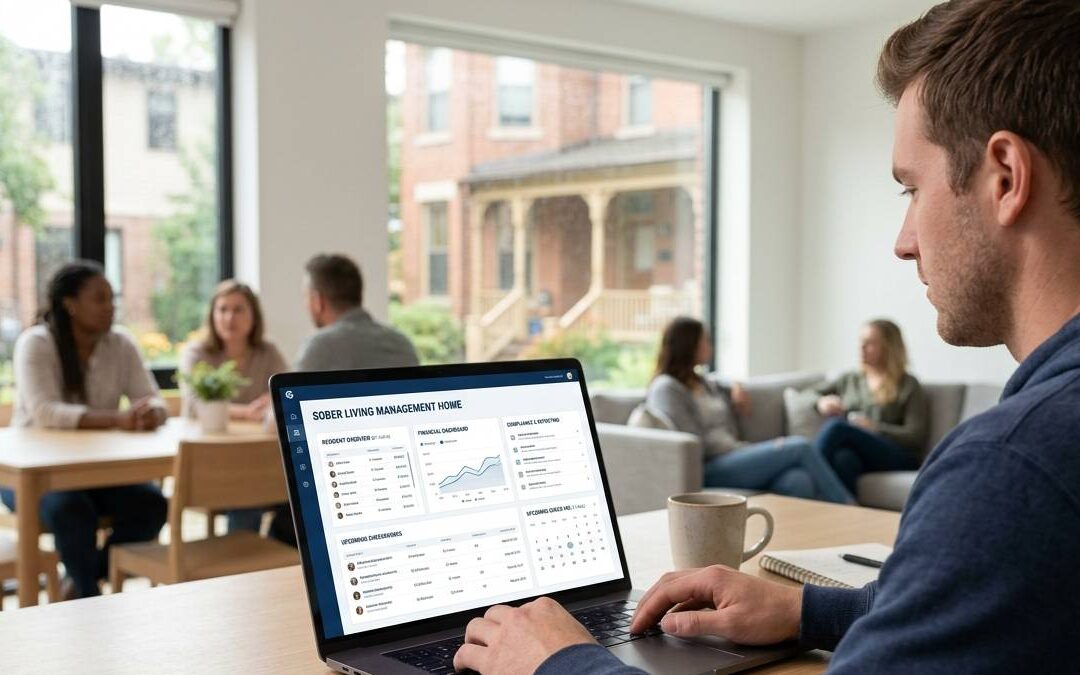
That is the role One Step Software is built to play. Built specifically for sober living and recovery housing – not adapted from property management or clinical software – One Step centralizes resident management, digital intake, accountability tracking, communication, and operational visibility into a single platform designed around how recovery housing actually runs.
Frequently Asked Questions
Do sober living homes need dedicated software, or can general tools handle it?
General tools can handle parts of sober living operations, but they tend to break down as programs grow. Intake documentation, resident accountability tracking, incident reporting, and multi-house visibility are needs that generic software was not designed to meet. Operators who start with general tools often find themselves managing multiple disconnected systems – which creates exactly the administrative overhead they were trying to avoid.
What is the difference between sober living software and an EHR platform?
Electronic health records were built for licensed clinical providers who need clinical documentation and insurance billing. Sober living homes operating at Level I or II under NARR standards do not deliver clinical treatment, so an EHR typically brings more complexity and cost than the operation requires. Purpose-built sober living software like One Step focuses on resident management, house operations, accountability, and documentation.
How does software support NARR certification?
NARR’s operational standards require documented policies, resident agreements, incident reporting, and consistent application of house rules across the program. Software that centralizes these records makes it easier to demonstrate compliance during certification reviews and maintain consistency through staff changes. Multi-house operators especially benefit from platforms that apply standardized templates across all locations.
What should operators prioritize when evaluating sober living software?
Fit with the actual workflow and ease of use for house managers should come first. Beyond that, look at whether the platform supports multi-house operations, how intake and onboarding work, what accountability and communication tools are included, and what the realistic learning curve looks like for staff without clinical or IT backgrounds.
When does it make sense to move from basic tools to dedicated software?
The clearest signal is when documentation starts creating operational problems – missed signatures, incomplete records, difficulty locating files during inspections, or staff spending more time on paperwork than on residents. For most programs, that point arrives well before a second house opens. Operations that are growing, seeking certification, or building referral relationships benefit from making the transition earlier rather than later.