
Key Takeaways
- NARR Standard 3.0 requires a minimum of 50 to 60 square feet per resident in shared sleeping rooms, and building codes in most jurisdictions require at least 70 square feet for the first occupant and 50 additional square feet per additional occupant. Bedroom count and size determine the program’s financial viability before any other factor.
- Zoning must be verified before any purchase commitment. Under the Fair Housing Act and ADA, people in recovery are a protected class, and municipalities cannot use zoning to discriminate against recovery housing, but local rules still apply and vary significantly by municipality.
- A property with fewer than four bedrooms is unlikely to generate sufficient revenue to cover operating costs, including a house manager. Industry experience consistently points to four to six bedrooms housing six to twelve residents as the financially viable baseline for a Level II sober living program.
- Standard homeowner and landlord insurance policies do not cover sober living operations. Specialized coverage is required before the home opens, typically costing $2,000 to $8,000 annually.
- One Step Software gives operators the operational infrastructure to run a compliant, well-documented program from day one, which protects the investment made in the property and builds the credibility that referral partners and certifying bodies expect.
Buying the wrong property is one of the most expensive mistakes a sober living operator can make. A house that looks like a good deal on paper can turn into a compliance problem, a zoning fight, an undercapitalized operation, or a property that simply does not work for group living. Getting the property decision right from the start saves time, money, and a significant amount of operational headache.
This article is for operators who are either planning to purchase a property to operate as a sober living home or are evaluating whether an existing property can be converted. It covers what to look for, what to verify before committing, and how to think about the financial side of the decision.
Start With Clarity on What Level of Program You Are Running
Before evaluating any property, the operating model needs to be clear. A Level I peer-run home has different space and staffing requirements than a Level II monitored home with a house manager. A program serving women with children needs a different space than one serving single adults. A home that will participate in drug court placements may need to meet specific documentation and communication standards that affect how the house is configured and managed.
NARR’s four-level framework shapes what the property needs to support. Most new operators start at Level I or Level II, which have the simplest staffing requirements and represent the majority of recovery residences nationally. Those levels also have the most established certification pathways, the widest referral network access, and the clearest property requirements to plan around.
Deciding on the level before starting the property search means evaluating every property against the right criteria rather than picking a property first and trying to fit the program around it afterward.
The Property Characteristics That Actually Matter
Bedroom count and configuration are the single most important factors for financial viability. A home with fewer than four bedrooms will struggle to generate enough revenue to cover operating costs, including a house manager. The sustainable baseline for most Level II programs is four to six bedrooms housing six to twelve residents. Operators who try to run a program in a three-bedroom house often find themselves subsidizing it personally rather than running a financially sustainable operation.
Within bedrooms, size matters. NARR’s standards require a minimum of 50 to 60 square feet per resident in shared sleeping rooms. Local building codes typically require at least 70 square feet for the first occupant plus 50 square feet per additional occupant. Rooms that are technically large enough to house two residents but feel cramped will affect resident experience and turnover. Operators who switch from bunk beds to individual twin beds consistently report longer average stays and fewer behavioral incidents, which affects revenue more than the marginal capacity increase from bunk beds.
Bathroom ratio is the second key factor. The standard planning ratio is one bathroom per four to six residents. A six-bedroom home housing ten residents with a single bathroom creates daily friction and resident complaints that affect house culture. Two bathrooms are the realistic minimum for most programs of that size.
Common areas need to function for group living. A living room large enough for house meetings, a kitchen and dining area that can accommodate the household, laundry facilities on-site or nearby, and outdoor space for recreation all matter for daily operations. A house that lacks functional common areas creates operational problems that cannot be solved by good management.
Bedroom egress is a safety and code compliance issue that gets missed in property evaluations. Every bedroom used for sleeping must have an operable window or door that meets egress requirements under the applicable building code. Finished basements or attic rooms that lack compliant egress cannot legally be used as sleeping areas, which affects the usable capacity of the property.
Location: What Supports Recovery and What Creates Risk
Location for a sober living home is not about prestige or real estate appreciation. It is about whether the property supports the daily routines of people in early recovery.
Proximity to public transportation matters in most markets because residents in early recovery often do not have reliable vehicles. The ability to get to work, to meetings, to outpatient appointments, and to grocery stores without a car is a practical daily reality that affects whether residents can meet their program obligations. In suburban or rural settings where transit is limited, parking availability and proximity to major employers become more important.
Access to recovery meetings, outpatient treatment programs, and healthcare within a reasonable distance supports the ongoing recovery work that sober living is designed to complement. A home that is isolated from those resources creates barriers that house managers cannot overcome.
The neighborhood environment matters differently. A quiet, stable residential area without high concentrations of bars, liquor stores, or active drug activity nearby reduces the environmental triggers that can affect residents in early recovery. This is not about avoiding all exposure to the world, but about not placing residents in an environment that works against what the program is trying to support.
Zoning: Verify Before Committing
Zoning is the most common obstacle for new sober living operators, and the most expensive mistake to discover after a purchase is committed. The legal framework is clear: under the Fair Housing Act and the ADA, people in recovery are a protected class, and municipalities cannot use zoning to discriminate against recovery housing. But what local governments can and cannot do varies significantly by jurisdiction, and understanding your specific situation before signing a purchase agreement is essential.
In most jurisdictions, a sober living home housing six or fewer unrelated adults can operate in a single-family residential zone without special permits. Many areas allow more residents with appropriate zoning approval. But some municipalities have enacted spacing rules, conditional use permit requirements, or occupancy caps that apply specifically to group homes, and some of those are legally challengeable while others are not.
The verification process should involve a direct conversation with the local planning or zoning department before any purchase commitment. Ask specifically about how the municipality classifies a home housing multiple unrelated adults in recovery. Ask whether a use permit or business license is required. Ask whether there are spacing requirements for group homes. Get responses in writing where possible. If you encounter resistance that appears discriminatory, consult a fair housing attorney before proceeding.
State certification requirements add another layer. In states like Virginia, where certification is now mandatory, or in states where certification is required to receive referrals from state agencies, the property needs to meet the physical environment standards of the relevant certifying body before those referral pipelines are accessible.
Fire Safety and Building Code Compliance
Fire and life safety compliance is non-negotiable regardless of state or local certification requirements. The standards that apply to a residential property housing multiple unrelated adults in group living include working smoke detectors in every bedroom and common area, carbon monoxide detectors, fire extinguishers, clear egress paths, and compliance with occupancy limits for each room.
A professional fire safety inspection before purchasing a property intended for sober living is a practical step that most operators skip and many regret. A proactive inspection with the local fire marshal, or a private inspection by a qualified inspector, identifies issues that would need to be remediated before the home can open. Discovering those issues after closing on a purchase is more expensive than discovering them during due diligence.
NARR certification inspections and state affiliate site visits will verify fire and life safety compliance. A property that fails those checks cannot be certified, and an uncertified home in states with referral requirements or funding conditions tied to certification will struggle to build the occupancy it needs to be financially viable.
The Financial Picture
A four-bedroom home housing six to eight residents at $700 to $1,000 per month per resident generates gross revenue of $4,200 to $8,000 per month before expenses. Operating costs, including a house manager, utilities, insurance, supplies, and maintenance, typically run $2,000 to $4,000 per month, depending on the market and management model. That leaves operating margins that work at consistent occupancy but require planning for the first three to six months when occupancy is building.
Standard homeowner and landlord policies specifically exclude group living and commercial operations. Operators who open without specialized insurance are personally exposed to liability from the first day. Specialized recovery housing insurance covering general liability, professional liability, and property damage for group-living environments typically costs $2,000 to $8,000 annually. That cost should be factored into the financial model before purchase.
Financing options for a property intended as a sober living home include conventional purchase with a residential mortgage if the operator intends to live on-site, DSCR loans for investment properties, hard money financing for quick acquisition with later refinance, and seller financing, where available. For operators with nonprofit status, community development financial institution loans and HUD programs may also be available. The right financing structure depends on the operator’s specific situation, the property type, and the intended business model.
What This Looks Like in Practice
In practice, operators who make good property decisions have done their homework before the purchase rather than during it. They know what NARR level they are operating, what bedroom and bathroom configuration supports that program financially, what zoning verification they need, and what the fire safety and code compliance picture looks like.
They have also thought about the operational systems that will run in the property from day one. A well-selected property with disorganized operations will underperform. A well-selected property supported by clear documentation systems, consistent resident accountability, and organized records will build occupancy faster and maintain it more reliably.
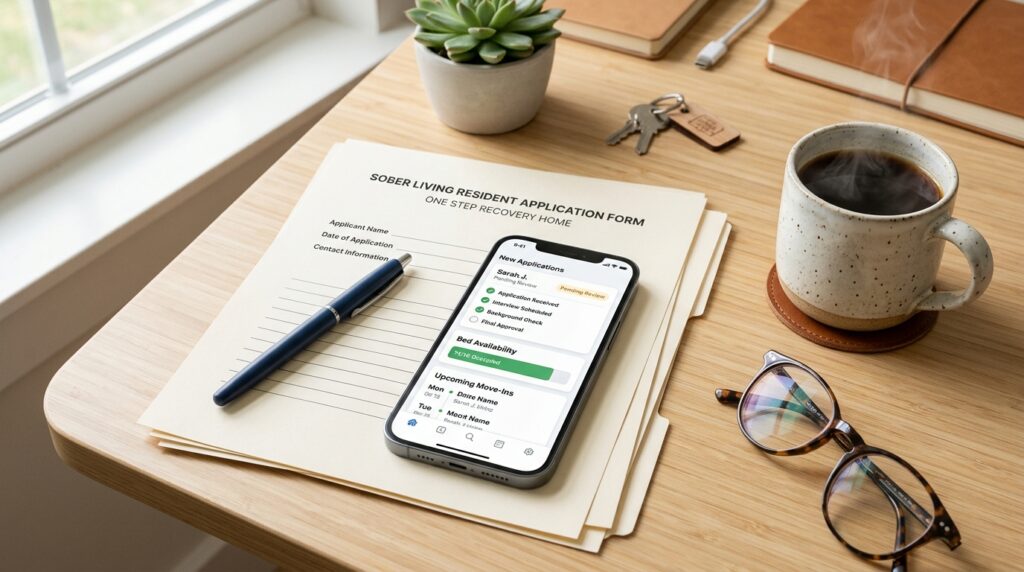
One Step Software gives operators the operational infrastructure from day one, centralizing resident intake, documentation, accountability tracking, and communication in one platform so that the investment in the property is supported by the management consistency that makes the program credible to certification bodies, referral partners, and residents.
FAQs
What is the minimum number of bedrooms needed for a financially viable sober living home?
Most experienced operators point to four bedrooms as the practical minimum for a program that can cover its own operating costs, including a house manager. A three-bedroom home typically cannot generate enough revenue to support a fully operational program. Four to six bedrooms housing six to twelve residents is the financially sustainable baseline for most Level II programs.
Can I use a standard mortgage to purchase a property for sober living?
A standard residential mortgage can be used if the operator intends to live on the property, which applies to some Level II configurations with a live-in house manager who is the owner. For properties purchased purely as investment or business properties, commercial or investment financing is typically required. DSCR loans, which qualify based on the property’s income potential rather than personal income, have become a common vehicle for sober living property purchases.
How do I verify zoning before purchasing?
Contact the local planning or zoning department directly, describe the intended use, and ask specifically about classification, permit requirements, occupancy limits, and spacing rules. Get responses in writing. If the answers are unclear or the situation appears legally complex, consult a land use attorney with fair housing experience before signing a purchase agreement.
What insurance do I need before opening?
Standard homeowner and landlord policies do not cover sober living operations. You need specialized insurance covering general liability, professional liability, and property damage for a group-living recovery environment. Budget $2,000 to $8,000 annually and work with a broker who has experience in behavioral health or group home coverage.
How does the property need to be configured to meet NARR certification requirements?
NARR’s physical environment standards require minimum bedroom square footage per resident, adequate bathroom ratios, functional common areas, compliant fire and life safety systems, and a home-like environment that supports the social model of recovery. A certification pre-inspection with your state affiliate before finalizing a purchase or renovation can identify gaps before they become costly surprises during the formal inspection process.