
Key Takeaways
- SAMHSA’s National Survey on Drug Use and Health estimates that approximately 48.7 million Americans aged 12 or older had a substance use disorder in the past year, representing a structural demand for recovery housing that far exceeds current supply in most markets.
- Industry data shows that approximately 60% of sober living admissions come through professional referral networks, 25% through online search and digital presence, and 15% through community engagement and word of mouth.
- SAMHSA’s Behavioral Health Treatment Locator and the NARR directory are among the most widely used tools by discharge planners and case managers searching for placement options. Not being listed on these is a straightforward missed opportunity.
- Responding to inquiries within minutes rather than hours is one of the most reliable ways to convert interest into applications. Families and treatment teams often reach out during a critical transition window. Slow response loses those opportunities before they develop.
- One Step Software supports the application and intake process by centralizing resident inquiries, tracking application status, and making it easier to move from first contact to move-in without administrative delays.
Empty beds are not usually a demand problem. In almost every market in the United States, more people need recovery housing than can find it. The gap between that demand and a specific home’s occupancy rate is almost always a visibility and trust problem. People who need sober living either do not know your home exists, cannot find it easily, or have not yet been given a reason to choose it over the alternatives.
Getting more applications means solving for both of those things: being findable, and being credible when people find you. Neither requires a large marketing budget. Both require consistency and deliberate effort.
The Foundation: Referral Relationships Drive Most Admissions
The most reliable source of consistent applications for a sober living home is not advertising or social media. It is professional referrals from treatment centers, IOP programs, hospital discharge planners, probation departments, and drug courts. Industry experience consistently points to referrals as the source of the majority of admissions for well-run programs, particularly as the home develops a track record in its community.
The relationship-building work that generates those referrals is covered in the article on working with treatment centers. The point worth repeating here is that referral volume is largely a function of how well-known and trusted the home is among the professionals who make placement decisions. Operators who spend time visiting discharge planners, providing clear program information, and responding reliably when those relationships generate inquiries will see consistent application flow that advertising alone cannot replicate.
For homes that are new or that are trying to increase their referral volume, the most practical starting point is identifying the five to ten discharge planners and case managers most likely to refer residents to a home at your NARR level. Schedule introductory visits. Leave a one-page program summary. Follow up with a weekly bed availability update. Over three to six months, the consistent presence builds the familiarity that generates calls.
Being Findable Online
Referrals generate consistent volume once established, but most families and individuals searching for sober living start with an online search. A home that does not appear in those results or appears with outdated information is invisible to a significant portion of the people who need it.
The most important online presence for a local sober living home is a Google Business Profile. This is the listing that appears in Google Maps and local search results when someone searches for sober living near them. Setting it up is free and takes about an hour. The profile should include the home’s address, phone number, program description, photos, and current bed availability updated regularly. Reviews from past residents and their families, posted voluntarily, add credibility that no paid listing can replicate.
Directory listings are the second priority. SAMHSA’s Behavioral Health Treatment Locator, the NARR directory, and Sober House Directory are the platforms most commonly used by case managers and discharge planners searching for placements. Being listed on all three costs nothing beyond the time to create and maintain the listings. Being absent from them means being excluded from the consideration set of the professionals generating the most consistent referral volume.
A simple website rounds out the online presence. It does not need to be elaborate. It needs to clearly answer the questions someone in crisis is asking: what the program includes, what it costs, what the rules are, who it serves, and how to apply or inquire. A phone number and an application or contact form that goes to someone who responds promptly converts interest into applications. A website that goes to voicemail or an unmonitored inbox does not.
Response Speed Is a Competitive Advantage
One of the most consistently overlooked factors in application volume is how quickly inquiries are handled. Families and treatment teams often reach out during a narrow window when someone is being discharged or is in crisis. A response within minutes turns an inquiry into a conversation. A response the next day often means the person has already moved to the next home on the list.
Answering calls quickly, responding to texts and online form submissions within a few minutes, and having a clear and simple intake process that can move from first contact to a confirmed bed quickly are operational habits that directly affect how many applications convert to admissions. Treatment center discharge planners in particular learn quickly which homes can act fast and which cannot. The fast, responsive ones get called first.
This is an area where having clear operational systems makes a direct difference. A house manager who is also managing residents and house operations may not be the right person to be the first point of contact for every inquiry. Having a defined intake process, even a simple one, with clear ownership of who responds to inquiries and how quickly, removes the inconsistency that costs occupied beds.
The Role of Alumni and Community Presence
The recovery community is a word-of-mouth network. People in AA and NA meetings, outpatient programs, peer support groups, and recovery community organizations talk about their experiences and make recommendations to others who are looking for housing. A home with a good reputation in that network generates a steady flow of direct inquiries that cost nothing to generate.
Building that reputation starts with running a good program. Residents who complete their program successfully and feel well-served are the most credible voices the home has. Some operators formalize this through alumni relationships, inviting graduates to speak at intake orientations, participate in community events, or stay connected through a program alumni group. Others keep it informal. The mechanism matters less than the underlying reality: homes that treat residents well and produce good outcomes develop reputations that generate applications.
Participation in the recovery community more broadly, attending local coalition meetings, sponsoring recovery events, staying connected with peer recovery organizations, and being visibly engaged with the work of recovery in the area, builds the kind of recognition that turns into direct inquiries over time.
Transparent Program Information Converts Inquiries Into Applications
A common reason applications stall at the inquiry stage is that potential residents or their families cannot get clear information about what the program costs, what the rules are, and what the application process involves. Ambiguity at this stage creates friction and often results in the person moving on to a home that makes the information easier to find.
Being transparent about costs, house rules, application requirements, and what happens during intake removes that friction. Families dealing with a loved one in crisis do not have the patience for multiple follow-up calls to get basic information. A home that answers those questions clearly and quickly, whether through a website, a program summary, or a direct conversation, converts more inquiries into completed applications.
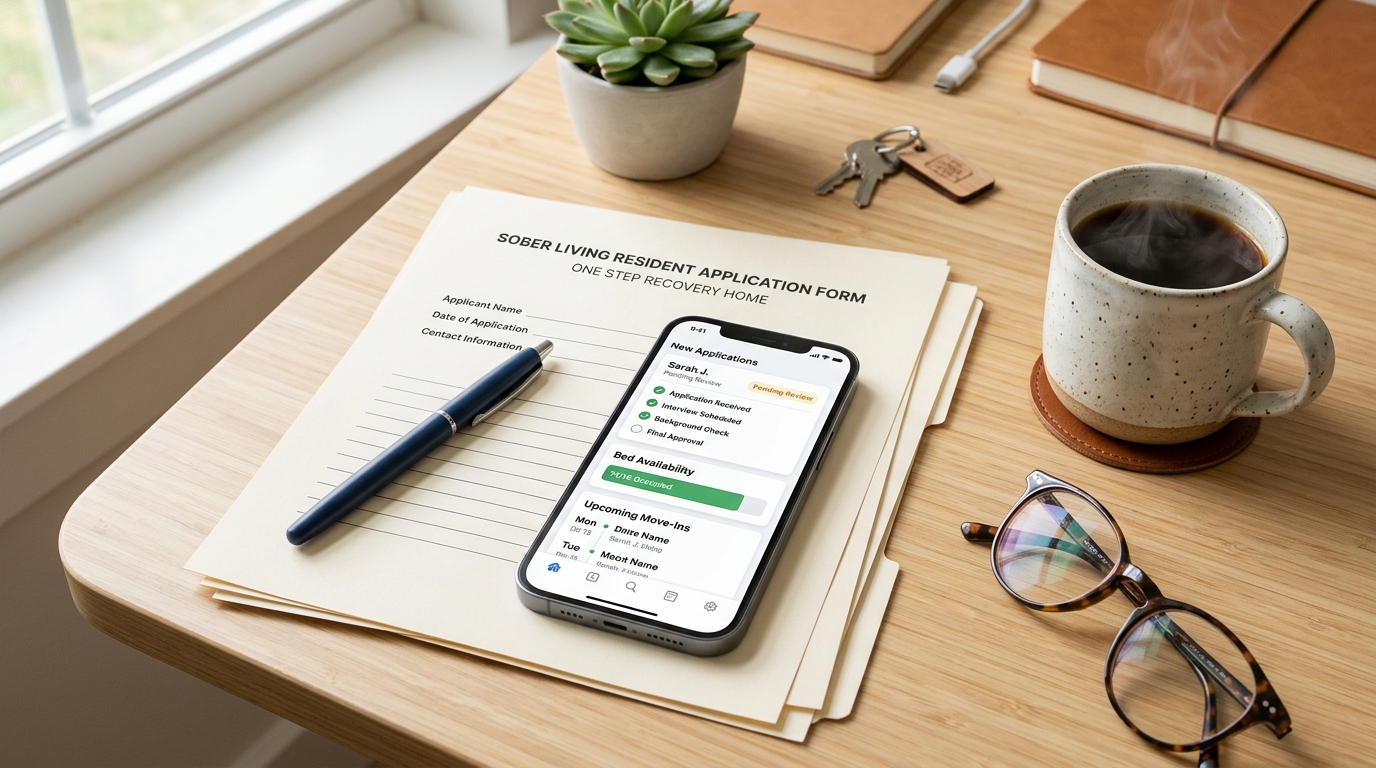
One Step Software supports this process by centralizing application management, tracking inquiry status, and making it easier to move from first contact to completed intake documentation without things falling through the cracks. When an operator can see exactly where every prospective resident is in the application process, follow-up is timely and no one gets lost in the pipeline.
One Step Software also offers a Lead Form feature, a digital application form built for the operator’s website that captures inquiries directly rather than routing them through a phone call or email that may go unanswered. Prospective residents or their families can submit an application at any hour, and the operator receives it immediately rather than waiting for someone to check voicemail or an inbox.
Outcomes Data as a Marketing Tool
Most sober living operators underestimate the value of their own outcomes. If residents at your home are staying longer, maintaining sobriety at higher rates, and finding employment more reliably than average, that information is worth sharing. Not as a boast, but as evidence for discharge planners, families, and prospective residents trying to decide whether your program is worth trusting.
A 2025 systematic review published in Frontiers in Psychiatry found that recovery housing consistently outperformed standard care on abstinence, employment, and criminal charges across follow-up periods of six to twenty-four months. The national evidence base for recovery housing is strong. The specific evidence for your program is even more persuasive to someone evaluating where to send a patient or family member.
Tracking average length of stay, program completion rates, and employment outcomes at 60 or 90 days requires organized records, but it is not complicated to maintain. One Step Software stores that data as a natural output of the resident management process, making it available when a clinical director asks for outcome information or when an operator wants to put together a program summary for a new referral partner.
What This Looks Like in Practice
In practice, operators with consistent application flow have built three things: referral relationships with the treatment programs and courts in their area, a findable online presence that answers basic questions clearly, and a response process that turns inquiries into conversations quickly.
None of this requires sophisticated marketing. It requires showing up consistently, being responsive, maintaining a program that people speak well of, and keeping the operational systems in place that make it easy to move from an inquiry to a completed application.
One Step Software is built to support that last part, centralizing resident intake, documentation, and communication in one platform so that the administrative side of bringing in a new resident is as smooth as the relational side. If you’d like to see how the Lead Form and application tracking tools could work for your program, you can book a time to learn more.
FAQs
Why is my home not getting enough applications despite having available beds?
The most common causes are low visibility among referral sources, no presence or outdated presence in online directories, slow inquiry response times, or unclear program information that creates friction during the application process. Addressing all four systematically will produce better results than focusing on any one of them alone.
Is paid advertising effective for sober living homes?
Paid advertising tends to be the least efficient channel for most sober living operators. It generates inquiries from people who are often not well-matched to the program, has high cost relative to return, and does not build the durable relationships that referral networks provide. The exception is local Google search advertising, which can supplement a strong organic presence for homes in competitive markets. Referral relationships and organic search visibility should be established before paid advertising is considered.
How important are online reviews for a sober living home?
Reviews on Google Business Profile and similar platforms are a meaningful trust signal for families doing independent research. A home with several positive reviews from residents’ families appears more credible than one with none. Asking satisfied families to leave reviews voluntarily, and responding professionally to any negative feedback, builds the online reputation that supports organic inquiry volume over time.
How does a digital intake process affect application conversion?
A digital intake process that allows prospective residents to complete applications and submit documentation before arrival removes friction at the most critical point in the conversion funnel. One Step Software supports this by enabling digital intake forms and document collection, reducing the administrative back-and-forth that causes inquiries to go cold before they become admissions.
How do I track where my applications are coming from?
Asking every new resident at intake how they found the home is the simplest and most reliable tracking method. Over time, that data shows which referral relationships are generating the most volume, which directory listings are driving inquiries, and where to invest more relationship-building effort. Without that data, outreach decisions are based on assumption rather than evidence.